


Every August, something shifts in Melbourne.
It's not dramatic — no city-wide transformation, no overnight reinvention. But if you've lived here long enough, and you've been paying attention, you notice it. The tricolour going up at Federation Square. A queue outside a cinema for a film with no English subtitles and no marketing budget. A conversation in a foyer — between a filmmaker who flew in from Kerala and an audience member who grew up in Footscray — that neither of them expected to be having.
This is what the Indian Film Festival of Melbourne does. Not all at once. Not loudly. But consistently, over sixteen years, it has been doing something to this city that is harder to measure than ticket sales or attendance numbers: it has been making space.
A festival born from a specific hunger
When Mitu Bhowmick Lange founded IFFM in 2010, Melbourne already had one of the largest Indian diaspora communities in Australia. What it didn't have was a dedicated cultural infrastructure for that community's stories — at least not one that treated Indian cinema as something worth taking seriously on an international stage.
The first edition was, by most accounts, modest. It screened a curated slate of Hindi films — 3 Idiots, Dev.D, Kaminey among them — and featured Rani Mukerji as its focal point. The ambition, even then, was broader than Bollywood. But the festival had to build its audience before it could push them.
What's notable, in retrospect, is how quickly it did.
The moment the programming changed
By 2016, IFFM was doing something noticeably different. The fifth edition opened with Parched — Leena Yadav's raw, unflinching portrait of women in rural Rajasthan — and closed with Angry Indian Goddesses, Pan Nalin's ensemble film that had just won audience awards at Toronto and Rome. Alongside the mainstream nominees sat Thithi, a Kannada film made with non-professional actors from a single village, and Ottaal, a Malayalam adaptation of The Kite Runner set in the backwaters of Kerala.
The theme that year was Women's Empowerment. The festival didn't just screen films about women — it invited Richa Chadha to lead a masterclass, hosted panel discussions with women filmmakers, and created a programme that felt like an argument being made in public.
That's the year IFFM also won the Melbourne Award for Contribution to Multiculturalism by a Corporation. The city, officially, noticed.
What Federation Square means
There is something worth pausing on about the flag hoisting. Every year, on Indian Independence Day, IFFM raises the tricolour at Federation Square — one of Melbourne's most symbolically loaded public spaces, the civic heart of the city.
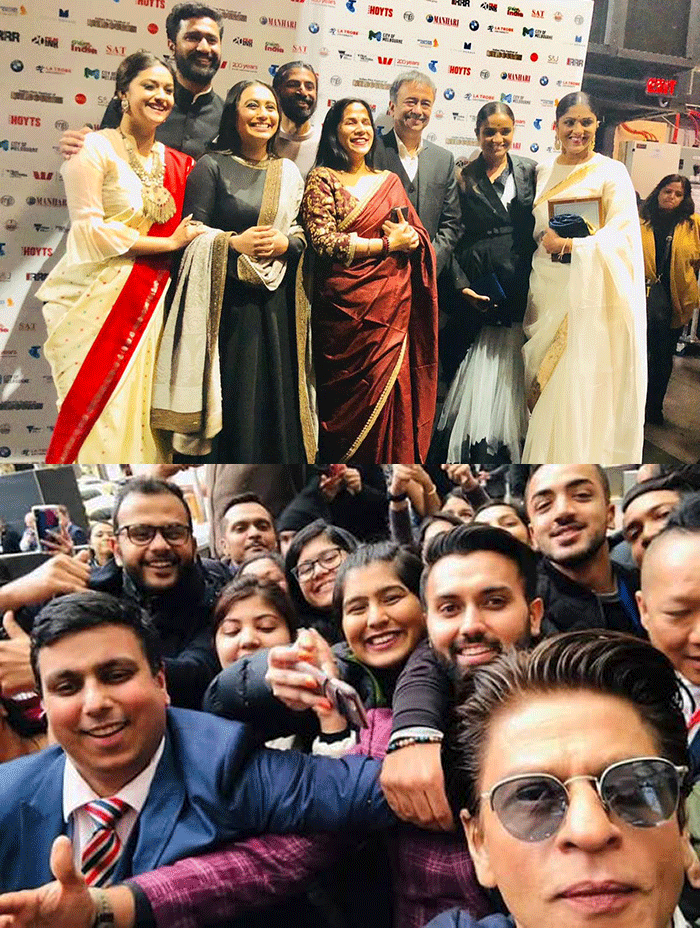
For the Indian diaspora here, that moment carries a particular weight. It is not a private celebration. It is a public one, in the middle of the city, witnessed by Melburnians of every background. Over the years, the crowd has grown — from a few hundred to thousands, particularly when figures like Shah Rukh Khan (2019) or Ram Charan (2024) have attended.
The flag hoisting was never really about celebrity. It was about visibility — about saying, in the most literal sense: we are here, this is ours too, and this city is large enough to hold it.
The films that stayed
A festival is only as meaningful as what it leaves behind — in conversations, in changed minds, in films that people carry out of the cinema and don't quite put down.
Several IFFM screenings over the years have done exactly that. The Great Indian Kitchen — a Malayalam film with no theatrical release and no stars — received a special mention at the 2021 festival and introduced it to audiences who had never heard of it. That film went on to become one of the most discussed Indian films of recent years, its quiet domestic rage resonating far beyond Kerala.
Laapataa Ladies won Critics' Choice Best Film at the 2024 edition — before much of the diaspora here had seen it. My Melbourne, the anthology commissioned by IFFM and directed by four Indian filmmakers, was built entirely around diaspora experience — stories of race, disability, sexuality, and belonging set in this city — and premiered here before releasing across Australia and India.
These weren't films that needed a festival to survive. But the festival gave them an audience, a context, and a conversation they might not have found otherwise.
What it means to see yourself on screen — in someone else's city
This is perhaps the least quantifiable thing IFFM does, and the most important.
For many in Melbourne's Indian diaspora — particularly those who arrived in the last decade, or who grew up here between two cultures — seeing Indian stories treated with seriousness on a public stage is not a small thing. It is, for some, the first time.
Not the sanitised, exoticised version of India that occasionally makes it into Western film festivals. Not the poverty tourism or the spiritual journey narrative told from the outside. But films made by Indians, about Indians, for an audience that doesn't need anything explained to them — and screened in their adopted city with the same care and attention as any other international cinema.
Bhowmick Lange has spoken about this directly: the films connect with the diaspora because they are, simply, home. The language, the texture, the specific way a conversation happens in a kitchen or a courtyard — things that don't need translation because the audience already lives inside them.
A city changed, slowly
Melbourne is a city that takes its cultural life seriously. It has a well-developed festival culture, a sophisticated arts audience, and a genuine appetite for cinema from outside the English-language mainstream. IFFM has, over sixteen years, inserted itself into that ecosystem — not as a niche cultural event for one community, but as a fixture on the broader Melbourne cultural calendar.
That shift didn't happen overnight. It happened film by film, conversation by conversation, flag hoisting by flag hoisting.
And it's still happening.