


There was a time when "Indian cinema" on the global stage meant one thing—song, spectacle, and a certain kind of larger-than-life storytelling. That version still exists, but it's no longer the whole picture.
Today, a quieter, more layered shift is underway. Stories rooted deeply in local realities are travelling further than ever before. And in doing so, they're reshaping how the world sees India—not as a monolith, but as a collection of voices, textures, and lived experiences.
The rise of the Hyper-Local
Some of the most compelling Indian films today don't try to be universally appealing at first glance. They lean into specificity—dialects, landscapes, cultural nuances that feel intensely personal.
A Malayalam film set in a small coastal town. A Marathi story unfolding in a single neighbourhood. A Khasi narrative rarely seen on screen—like Rima Das's Village Rockstars, shot entirely in Assam with a cast of non-actors, or Paithrukam quietly mapping the textures of Kerala. These films aren't diluted for a global audience. And that's precisely why they work.
Authenticity travels. Audiences everywhere recognise emotional truth, even when the setting is unfamiliar.
IFFM and the films that mattered
Since its founding in 2010, IFFM has consistently championed exactly this kind of cinema—before it became fashionable to do so.
The 2016 edition is a case in point. It opened with Parched—Leena Yadav's unflinching portrait of four women in rural Rajasthan—and closed with Angry Indian Goddesses, Pan Nalin's ensemble film that had just won audience awards at Toronto and Rome. That same year, Thithi—a Kannada film made on a shoestring with entirely non-professional actors from a single village—sat alongside the big-budget nominees. The message was clear: IFFM was not a Bollywood showcase. It was a platform for the full spectrum.
In 2021, when the pandemic had shrunk the world, IFFM expanded its slate to 127 films across 27 languages. Vidya Balan's Sherni won Best Performance Female, while an honourable mention went to Nimisha Sajayan for The Great Indian Kitchen—a film that had no theatrical release and no marketing budget, yet became one of the most-talked-about Indian films of the year.
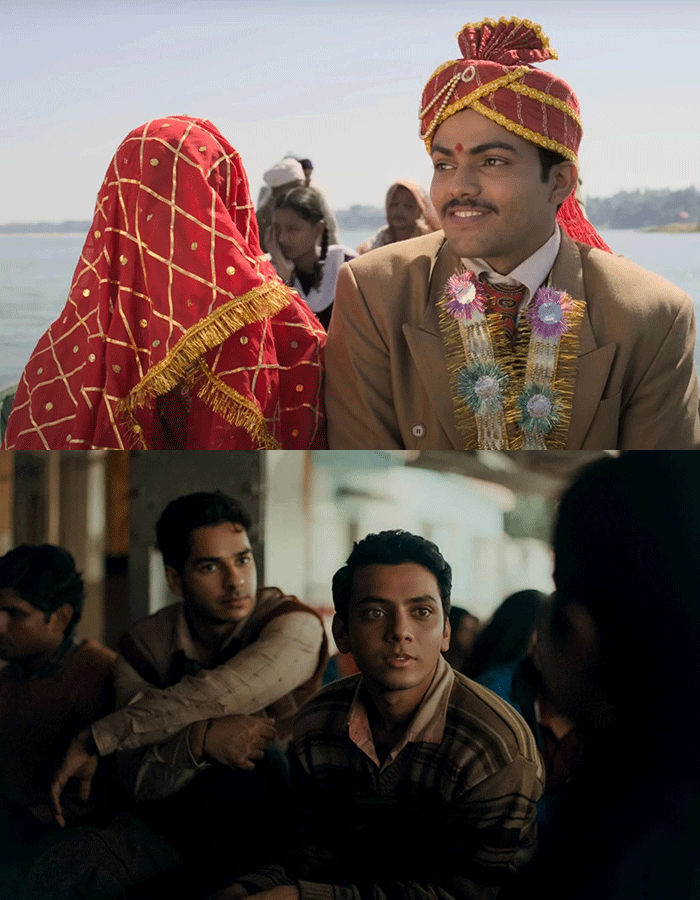
More recently, the 2024 festival awarded Best Film (Critics' Choice) to Laapataa Ladies—Kiran Rao's quietly radical comedy about two brides accidentally swapped on a train. And in 2025, Neeraj Ghaywan's Homebound swept the top honours for Best Film and Best Director, a film rooted in caste, queerness, and the small indignities of everyday India.
At IFFM, a small film can find a global audience overnight. A conversation started in Melbourne can echo in Mumbai, London, or Toronto.
Diaspora stories finding their voice
Another layer to this narrative is the evolution of diaspora storytelling. Earlier, these stories often revolved around nostalgia or cultural conflict. Now, they're more nuanced—exploring identity, hybridity, and belonging in ways that feel contemporary and complex.
IFFM's My Melbourne anthology is a striking example: four Indian directors telling stories of identity, race, disability, and sexuality set in modern Melbourne. It premiered at IFFM before releasing across Australia and India—cinema that didn't just bridge cultures, but lived inside the gap between them.
Second-generation voices, in particular, are redefining what it means to be "Indian" on screen. The lens is no longer about explaining culture—it's about expressing lived experience.
The festival effect
Film festivals do more than just screen films. They shape perception.
They create context through conversations, panels, and interactions between filmmakers and audiences. A film doesn't just play—it's discussed, dissected, and remembered.
This is where local stories stop being local.
A shift in storytelling power
What's changing isn't just the kind of stories being told—but who gets to tell them.
More first-time filmmakers. More women directors—from Leena Yadav to Kiran Rao to Payal Kapadia, whose All We Imagine as Light became the first Indian film in 30 years to compete at Cannes. More voices from regions that were historically underrepresented. There's a quiet democratisation happening, and it's visible on global screens.
The gatekeepers haven't disappeared—but they're no longer the only route.
So, What is the "New India Narrative"?
It's not one story.
It's a mosaic.
It's a Dalit filmmaker telling a story that was never told before—like Pa. Ranjith building an entire cinematic language around Ambedkarite politics. It's a small-town romance that feels more honest than grand declarations. It's a documentary that challenges, discomforts, and stays with you.
And it's an audience—global, curious, and ready—that's finally listening.
The Takeaway
The journey from local stories to global screens isn't about changing the story to fit the world.
It's about telling it truthfully enough that the world leans in.
And right now, Indian cinema is doing exactly that.