


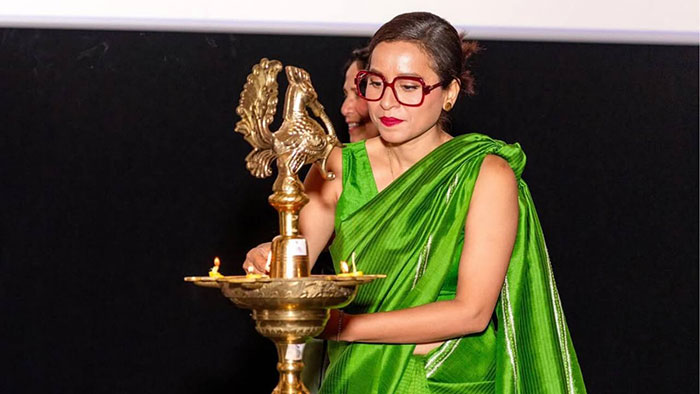
Indian cinema has always had powerful women on screen. But behind the camera? That’s a different story — one still being written, one frame at a time. And for over a decade, the Indian Film Festival of Melbourne (IFFM) has been one of the most consistent international stages on which that story is playing out. From programming choices to panel discussions to awards, IFFM’s relationship with women filmmakers isn’t incidental. It’s intentional. Here’s the arc of how it happened.
2016: The Year IFFM Made a Statement
If there’s a watershed year for women’s stories at IFFM, it’s 2016. The festival opened with Parched and closed with Angry Indian Goddesses — and also included panel discussions about women in cinema, with guests Sue Maslin, Leena Yadav, and Richa Chadha, who gave a masterclass on Bollywood and body positivity.
Think about the deliberate architecture of that: a film about rural women’s desire and agency opening the festival, a film about female friendship and violence against women closing it. That’s not scheduling — that’s a point of view. Leena Yadav, who directed Parched, also walked away with the Best Director award that year. A woman directed the opening film and won the top directing honour. In 2016, that meant something.
The Woman Running the Whole Show
Before we talk about the filmmakers, it’s worth pausing on the person who built the stage. IFFM was founded in March 2010 by film producer Mitu Bhowmick Lange via her company Mind Blowing Films — originally as the “Indian Film Festival: Bollywood and Beyond.”
In an industry where festival directors are overwhelmingly male, Mitu has spent 15+ years shaping which stories get an international platform. That’s structural power, used intentionally. Mitu has said: “It’s been wonderful to see so many incredibly strong and profound stories from female filmmakers. They are feisty, unapologetic and offer a new perspective. Right from issues about human rights to gender discrimination to emotional human stories, the wide range covers it all.”
2021: A Record That Deserved More Attention
The numbers from IFFM 2021 quietly told a remarkable story. Out of the 100 films selected for the 12th edition, 33 were by women filmmakers — not just feature film directors, but also women filmmakers in documentaries and short films. The lineup included National Award-winning filmmaker Rima Das, the director of the award-winning documentary Shut Up Sona, Cannes winner Aashmita Neogi, and Karishma Dev Dube, director of the Oscar-shortlisted short Bittu.
Bittu opened the festival’s gala night — a 17-minute short that defiantly questions human negligence. An opening night slot for a short film by a woman. At the largest Indian film festival outside India. That’s a choice worth celebrating. Rima Das — the Assamese filmmaker who shoots, directs, and edits her own films — has become one of IFFM’s recurring presences. Her film Bulbul Can Sing won Best Indie Film at IFFM 2019. She noted: “I have closely seen how Mitu Bhowmick takes a personal interest in encouraging women filmmakers and having diverse voices. She has been doing a commendable job year after year.”
Payal Kapadia: Before the World Caught On
In 2022, IFFM screened A Night of Knowing Nothing — Payal Kapadia’s documentary that had just won the Golden Eye (Best Documentary) at Cannes. It went on to win the Best Documentary award at IFFM that year. A Night of Knowing Nothing is at once an intimate letter to an estranged lover and a larger cry for India’s youth — weaving real footage from student protests with the fictional narrative of a female student at the Film and Television Institute of India.
It is the kind of film that a mainstream festival might have shied away from — politically charged, formally experimental, unabashedly feminine in its emotional register. IFFM screened it. IFFM awarded it.
Two years later, Kapadia made history by winning the coveted Grand Prix at the 77th Cannes Film Festival for All We Imagine as Light — becoming only the second Indian to win that honour since 1946. IFFM had seen her coming.
Aparna Sen: A Closing Night to Remember
The 2022 festival closed with Aparna Sen’s The Rapist — a film about sexual violence that won Best Director at IFFM that year, shared with Shoojit Sircar. The closing night screening was followed by a Q&A session with Aparna Sen on Zoom.
Sen is one of Indian cinema’s most enduring voices — a filmmaker who has never flinched from difficult subject matter. That her film both closed the festival and won its top directing honour is exactly the kind of validation IFFM has built its reputation on: not safe choices, but true ones.
2024: Women at the Centre of ‘My Melbourne’
IFFM 2024 showcased over 65 films in 26 languages, with 20 of them directed by women filmmakers. But the real landmark of that edition was the My Melbourne anthology — a bold new film initiative spearheaded by Mitu Bhowmick Lange that saw four iconic mentor directors (Kabir Khan, Rima Das, Onir, and Imtiaz Ali) work with emerging Melbourne directors on four short films — each celebrating one of the foundations of diversity: race, gender, disability, and sexuality.
Rima Das, the only woman among the four mentor directors, brought her quietly radical sensibility to a project that was, at its core, about belonging — something her own filmmaking has always explored.
What IFFM’s Commitment Actually Looks Like
It would be easy to say IFFM “supports women filmmakers” and leave it at that. What’s more interesting is how the support is structural, not symbolic. IFFM’s submission guidelines explicitly state that the festival particularly welcomes films by women filmmakers, filmmakers living with disabilities, and those who identify as members of the LGBTQIA+ community. That’s written into the rules — not just the press releases.
And then there are the programming choices, year after year: opening nights given to short films by women directors, closing nights anchored by women filmmakers, awards going to stories that centre female experience. IFFM’s stated vision is to ensure that voices from marginalised, LGBTQIA+, regional, and First Nations communities are not only seen but celebrated.
The Bigger Picture
As Rima Das put it: “World over, male filmmakers outnumber women filmmakers by a large margin. The stories are also often told from a male’s perspective. Even the top international festivals like Cannes, Toronto, and Berlin are seeing only a gradual rise in films by women filmmakers and women jury members.” Against that backdrop, IFFM’s record over 15 years stands out. This isn’t a festival that waits for the conversation to shift and then follows. It has been — quietly, consistently — part of shifting it.
The women filmmakers who’ve shown here — Leena Yadav, Rima Das, Payal Kapadia, Aparna Sen, Karishma Dev Dube and dozens more — didn’t just screen their films in Melbourne. They found an audience that was ready for them. A stage that was built for them. And a festival that believed, long before it was fashionable to say so, that their stories were worth telling.
Explore this year’s lineup at iffm.com.au