


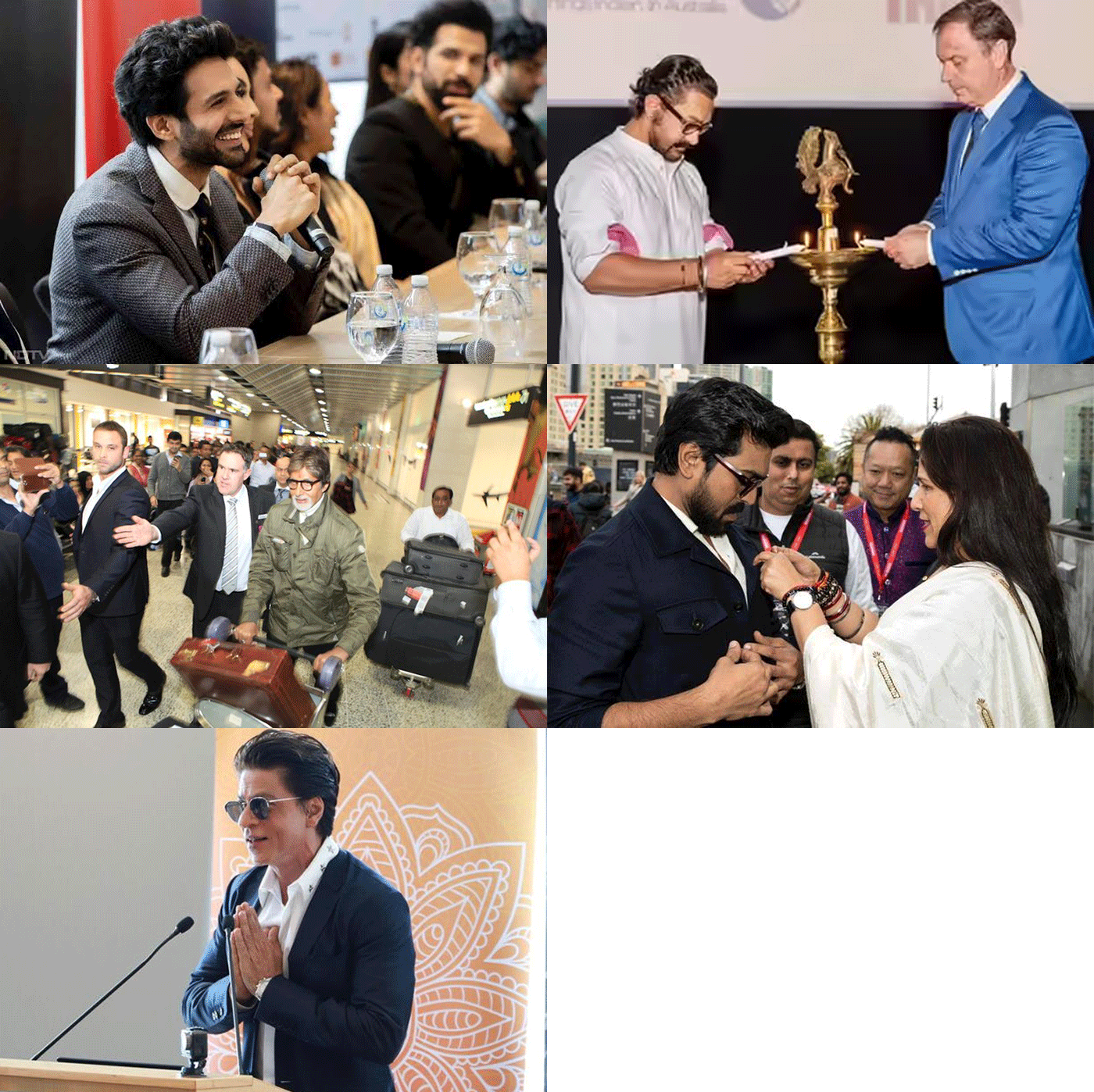
On diaspora longing, streaming's quiet revolution, and why a film festival in the Southern Hemisphere has become one of Indian cinema's most meaningful addresses.
Every August, something quietly extraordinary happens in Melbourne. A city already at ease with its own plurality - one where Vietnamese bakeries sit next to Ethiopian restaurants, where Punjabi radio drifts from car windows on the freeway - turns its face toward a specific kind of storytelling. The Indian Film Festival of Melbourne descends on the city with screenings, red carpets, masterclasses, and the particular electricity of a diaspora community watching itself, finally, on a very large screen.
In 2026, the IFFM is not merely a celebration. It is a reckoning with how far Indian cinema has travelled - geographically, culturally, and aesthetically - and with the profound questions that travel has raised about identity, representation, and the stories a nation chooses to tell the world about itself.
"More than just a film festival, IFFM is a platform that celebrates the heart of Indian storytelling - stories that are bold, intimate, layered, and deeply connected to tradition, community, and identity."
— IFFM Official Vision Statement
The largest celebration of Indian cinema outside India
The Indian Film Festival of Melbourne holds a distinction that still manages to surprise people who encounter it for the first time: it is the largest annual celebration of Indian cinema anywhere outside of India. The 2026 edition will take place in August as both a physical and online festival, with screenings held in cinemas across Melbourne — and, for the first time, with Brisbane joining the circuit — while simultaneously reaching audiences across Australia through the IFFM streaming platform, free to watch nationwide.
This dual format is not a concession to convenience. It is a statement about what Indian cinema has become: a form of storytelling that no longer asks permission to cross borders, that arrives in living rooms in Geelong and Cairns with the same ease as it fills a cinema in Kolkata or Coimbatore. The festival, presented by the State Government of Victoria, has grown into what its own vision describes as a bridge between the Indian film industry and the international stage — and in 2026, that bridge carries more traffic than it ever has.
A Diaspora that has grown into a force
To understand why the IFFM matters the way it does, you have to understand the Indian-Australian community it speaks to — and with. The numbers are striking. By June 2024, the Australian Bureau of Statistics recorded the Indian-born population in Australia at 916,330 individuals, having more than doubled in a decade. The Indian-born population is now on course to overtake England as the single largest country of birth for overseas-born Australians, a demographic shift that represents one of the most significant cultural transformations in the country's recent history.
Melbourne, in particular, is home to an Indian community that has moved well beyond the first-generation immigrant experience of negotiating visibility. The suburbs of Point Cook, Truganina, and Craigieburn have large concentrations of Indian families who have settled, raised children here, and built cultural institutions of their own. This is a community that is, as Indian Link's year-end analysis put it, 'no longer waiting to be invited to the table — it is already pulling up its own chair.'
For this community, the IFFM is not nostalgia. It is something more complicated and more necessary: a space where the hyphenated identity - Indian-Australian, Punjabi-Melburnian, Tamil and proud of it - is not a compromise but a premise. Where the films being screened reflect not just the India left behind but the India still being reckoned with, from the distance that migration always creates.
"Indian cinema is not a single thing. It never was. And a festival that understands this — that can hold Bollywood's grand narratives and the quiet power of regional independent films in the same breath — is doing something genuinely rare."
Indian cinema's moment on the world stage
The global conversation around Indian cinema has changed dramatically over the past four years, and the IFFM 2026 arrives at a moment when that conversation is at its most animated. The international breakthrough of SS Rajamouli's RRR — which won the Academy Award for Best Original Song for 'Naatu Naatu' and became a global streaming phenomenon on Netflix — fundamentally altered the terms on which Indian film is discussed abroad. Kantara, the Kannada-language mythological thriller from Karnataka, became a word-of-mouth sensation that crossed linguistic and cultural borders with little assistance from traditional distribution machinery. These were not Bollywood films in the conventional sense. They were regional stories told with extraordinary ambition, and the world received them as exactly that.
The trend has continued in 2025 and into 2026. Kiran Rao's Laapataa Ladies, India's official Oscar entry for 2025, swept the 70th Filmfare Awards with 13 wins — including Best Film, Best Director, and Best Actress — while simultaneously becoming a touchstone film for conversations about gender, rural India, and the quiet feminist cinema that has always existed at the margins of the mainstream. Payal Kapadia's All We Imagine As Light brought Malayalam and Hindi-speaking Mumbai to the Cannes competition, winning the Grand Jury Prize and placing Indian independent cinema on the most coveted stage in world cinema.
At the IFFM, these films are not simply screened. They become the starting point for conversations that the multiplex rarely enables — about what it means to make a film in a language spoken by forty million people and have it matter to someone watching in a cinema in Melbourne's CBD, about the creative ecosystems being built outside Mumbai and Chennai and Hyderabad, about the filmmakers whose names the global press hasn't yet learned but whose work demands to be seen.
Streaming has changed everything — and nothing
It would be easy to argue that festivals like the IFFM have been made redundant by the streaming revolution. Netflix, Amazon Prime Video, Disney+ Hotstar, and Zee5 have collectively made it possible for the Indian diaspora anywhere in the world to watch new releases within weeks of their theatrical run, sometimes simultaneously. The era when a film festival was the only place an Indian-Australian could watch a Malayalam film in anything approaching real time is, by and large, over.
And yet the IFFM has not only survived this shift — it has grown. The reason is worth sitting with. Streaming gives you access; a festival gives you context. Streaming is a solo act performed in the dark of a bedroom; a festival is a collective experience, the kind where the laughter in the row behind you during a Marathi comedy becomes part of the film itself, where a Q&A with a director can rearrange your understanding of a scene you thought you already knew. When actors like Ali Fazal and Freida Pinto sit on a stage in Melbourne for an IFFM panel, or when a filmmaker like Onir conducts a masterclass for emerging Australian-Indian creatives, something is happening that no streaming algorithm can replicate.
There is also a curation argument to be made. The Indian film industry now releases thousands of films a year across more than twenty languages. Streaming platforms, shaped by data and recommendation engines, have a tendency to surface the loudest signals — the biggest stars, the most-watched titles. A thoughtfully curated festival programme actively seeks out what the algorithm might miss: the debut documentary from a filmmaker in Assam, the short film that won a prize at a festival the mainstream press didn't cover, the regional language film that has no streaming deal but deserves an audience. The IFFM's commitment to showcasing 'voices from marginalised, LGBTQIA+, regional, and First Nations communities' is not a DEI checkbox. It is, in the current media landscape, genuinely countercultural.
"Streaming gives you access. A festival gives you context — and the irreplaceable experience of watching a story about your world with a room full of people who already know that world."
Cultural storytelling as soft power
There is a geopolitical dimension to the IFFM that rarely makes it into reviews of individual films but shapes the festival's significance in ways that are hard to ignore. The Australia-India relationship has deepened considerably over the past decade — in trade, in defence, in education — and the Indian diaspora in Australia has become a living connective tissue between the two countries. Cinema is one of the most effective instruments of cultural diplomacy ever devised, and the IFFM is, quietly, one of its most sustained expressions in this part of the world.
The flag-hoisting on India's Independence Day that has become part of the IFFM's programme — a moment when Bollywood stars have raised the Indian flag at Federation Square to an audience that includes both recent migrants and second-generation Australians who have never lived in India — is something more than spectacle. It is a ritual of belonging, one that acknowledges the complicated grief and pride that the diaspora carries, the way a national identity becomes both more vivid and more tender when you are living at a distance from it.
In 2026, with Indian cinema occupying an increasingly prominent position in the global cultural conversation, the IFFM's role as a space where these questions of belonging, identity, and representation are worked through in the dark of a cinema has become more rather than less important. The world has started paying attention to Indian stories. The question the IFFM asks — implicitly, through every screening choice and panel discussion — is: which stories, and told by whom, and for whose gaze?
The full spectrum: from Bollywood to the margins
One of the things that distinguishes the IFFM from festivals that treat Indian cinema as a monolith is its genuine commitment to the breadth of what that phrase contains. The festival's vision statement uses the phrase 'full spectrum of Indian cinema' and means it — from 'Bollywood's grand narratives to the quiet power of regional and independent films.'
This matters enormously in 2026, a year in which Indian cinema across languages has produced work of remarkable variety. In 2026 alone, the box office has already seen a 500 crore Rupee blockbuster in Dhurandhar: The Revenge alongside films with far smaller footprints but no smaller ambitions. Telugu, Tamil, Malayalam, Kannada, and Marathi cinema have continued to push at the edges of what mainstream Indian filmmaking looks like, while independent and documentary filmmakers across the country are producing work that often goes entirely unseen by the global press.
For an Australian audience, many of whom may know Indian cinema primarily through Bollywood's most internationally distributed titles, the IFFM offers something more valuable than a greatest-hits reel. It offers an education in complexity — in the reality that India's filmmaking landscape is as varied as its geography, as contested as its politics, and as alive to experiment as any national cinema in the world.
What 2026 looks like
The IFFM 2026 edition in August will operate in a landscape that has also been enriched by the emergence of the National Indian Film Festival of Australia, which ran across seven cities from March to July 2026. Rather than competition, this speaks to an appetite - a growing, confident audience for Indian cinema in Australia that two festivals can serve without cannibalising each other. Melbourne remains the centrepiece, but Brisbane's inclusion in the IFFM circuit signals that this is no longer a story about one city's relationship with Indian cinema. It is a national story now.
The masterclasses, the red carpets, the Independence Day ceremony, the screenings that run from studio blockbusters to debut short films - all of it constitutes something that is harder to name than a festival but more important than an event. The IFFM is, at its best, a space where Indian cinema is taken seriously: by the people who make it, by the diaspora who have been shaped by it, and by an Australian public curious enough to discover that the stories of 1.4 billion people are not all the same story, and that the difference between them is exactly where the most interesting cinema lives.
"IFFM exists to bridge the gap between the Indian film industry and the international stage, fostering meaningful dialogue between cultures through the universal language of cinema."
— IFFM Official Mission
In a world that increasingly flattens cultural difference into content categories, a festival that insists on the specificity of Indian storytelling — on the particularity of a Manipuri grandmother's dialect, a Mumbai chawl's architecture, a Rajasthani village's sky at dusk - is performing an act of cultural resistance as much as cultural celebration. The Indian Film Festival of Melbourne, in August 2026, matters more than ever. Not because Indian cinema needs its endorsement. But because the conversation it makes possible - between filmmakers and audiences, between India and its diaspora, between stories and the people who needed them — is one that no algorithm, no streaming queue, no recommendation engine has yet learned to replicate.
That conversation happens in a cinema. It happens in Melbourne. And in 2026, it is more alive than ever.